
Dropbar MTBs are an underrated, versatile, and weird bike that aren’t often seen or discussed but might offer a good alternative for the type of roads, trails, and terrain some of us are out there riding. My purpose here isn’t to convince anyone that dropbar MTBs are the best, only, or optimal option, but rather to discuss what they are, provide some context, give a few tips, and think about what benefits they may offer. So, what are dropbar MTBs? Aren’t they just gravel bikes, and aren’t those really just XC bikes from the 1990s? Maybe. I have some thoughts on gravel bikes, XC bikes, and dropbars. Let’s start with the gravel bikes and think about whether or not they are 1990s XC bikes, look at where dropbar MTBs might fit in this discussion, and finally find out why you might want to ride a dropbar MTB.
So, what are dropbar MTBs? Aren’t they just gravel bikes, and aren’t those really just XC bikes from the 1990s?
Gravel bikes are just 1990s XC bikes.
This has been a common response to the rising popularity of gravel bikes over the past decade or so. Is there any truth here? Yes and no. There are some clear differences in the bikes themselves: one has flat bars, one had drop bars and one has 26″ wheels and the other (usually) 700c. However, those flat bars were often a similar width to the drop bars on some gravel bikes and a 26×2.0″ tyre isn’t that far off from modern 700×40-something gravel tyres.
What these bikes have in common has less to do with how they appear, but more to do with how they were and are used. While there’s been a strong free ride (FR) and downhill (DH) movement in mountain biking nearly from the beginning, I would argue that this way not the experience most sought out on their 26″ wheels, 130mm stems, and 555mm flat bars. Gravel roads and pretty tame singletrack were more the norm than 2m drops and huge gaps. Those same gravel roads and tame singletrack are exactly where many choose to ride their gravel bikes today, and these two types of bike arrived on this common gravel from different origins; while the XC MTB was sometimes found lying on the ground with a bent fork just short of a 3m gap, today’s gravel bikes are more likely to be found leaning against a cafe window nowhere near even a ‘class 1’ gravel road. A lot of this is must be blindingly obvious to those who have been riding MTBs for a few decades, but I imagine there are more out there who haven’t had this privileged background.
All that said, I think it’s also important to recognise that what qualifies as gravel today is a highly variable. You can see this reflected in the Silca Surface Guide, which breaks gravel down into many subcategories ranging from what most would just call a road to a moderately technical MTB trail. Considering this, it’s not hard to see why there’s some disagreement if a forgotten form of mountain biking is equivalent to a current form of cycling with no consistent definition. However, I will argue that when we look at the range of what 1990s XC MTBs were used for in the 1990s there is a significant overlap with what current gravel bikes are used for, and they are functionally quite similar. So, from the perspective of an aging mountain biker, yes, these gravel bikes are clearly a modern take on the early MTBs.
Gravel bikes are not 1990s XC bikes.
This is obvious. One has purple and teal anodised aluminium bolted all over it, and the other. Hmm. Aside from the cyclical nature of cycling trends (the return of brightly anodised aluminium should be universally celebrated), there’s a pretty convincing argument that the gravel bike is not a reincarnation of the 1990s MTB, but a reasonable evolution of the road bike.
Just look at them. To the casual observer, a road bike from the 1950s through today are largely the same, and both are virtually indistinguishable from a gravel bike. There’s a reason for this, it’s because they are do roughly the same thing and in the same way with drop bars, rigid forks, no rear suspension, and big wheels with relatively narrow tyres.
Most gravel bikes, like their road bike equivalents, are ridden on the road. That road might be concrete, asphalt/macadam, chip seal, or gravel, but it’s still a road. Furthermore and from what I’ve seen, I’m not so sure there’s always so much distinction between these roads as many of them are in pretty rough shape. The Victorian roads around here aren’t exactly the idea use case for a nice cotton road tyre, especially if you want to keep air in it and like your wheels true.
This sort of evolution that I’m describing isn’t limited to bicycles. Look back at that road, regardless of surface type. Who else is there? Probably someone driving an SUV. What is an SUV in 2026? An SUV in 2026 is a minivan in form, function, and appearance. Perhaps these people-moving neo-minivans are adapted to the roads in a way not too dissimilar to the gravel bike.
Perhaps some of those same self-conscious societal pressures that pushed people away from the minivan to the Tonka truck version are the same that keep the MAMIL from choosing the obvious endurance road bike and instead choosing the adventury-looking gravel bike. Maybe the frame/top tube/handlebar bag is to the gravel bike as the roof rack/basket/awning/snorkel is to the SUV; both are probably saying more about what the rider/driver wants you to think rather than what they’re actually doing? Surely today’s gravel rider doesn’t want you thinking they’re some dirty, Redbull-swilling mountain biker (we all know this is unambiguously communicated via handlebar shape). But, I imagine there’s an equal number of gravel cyclists whose primary objection here is the word ‘biker‘. Whatever the case, many of these cycling disciplines seem a bit cliquey and we might all do better to move past them and get back to the riding, or perhaps (critiquing) racing.
What about gravel racing? I have no idea what the spirit of gravel™ is, but gravel races are looking increasingly similar to traditional road racing. Pace lines, echelons, and aero water bottles? This isn’t a judgement of gravel racing, but rather an observation that it seems to be maturing into a sport that’s closer to road racing than any of the numerous forms of MTB racing I’m aware of. Does anyone else miss dual slalom? I’m looking forward to the inevitable gravel individual and team time trials (GTT / GTTT) and I’m sure the gravel-specific aero/TT helmets (scroll to the bottom) will be truly awe inspiring.
Ok, so what about these dropbar MTBs?
Returning to my initial question, I’m not sure if asking if a gravel bike is an old XC bike is really all that useful. Clearly the answer depends on who’s asking what they think gravel means. What’s a better question? I have no idea, but a good answer just might be “dropbar MTB“.
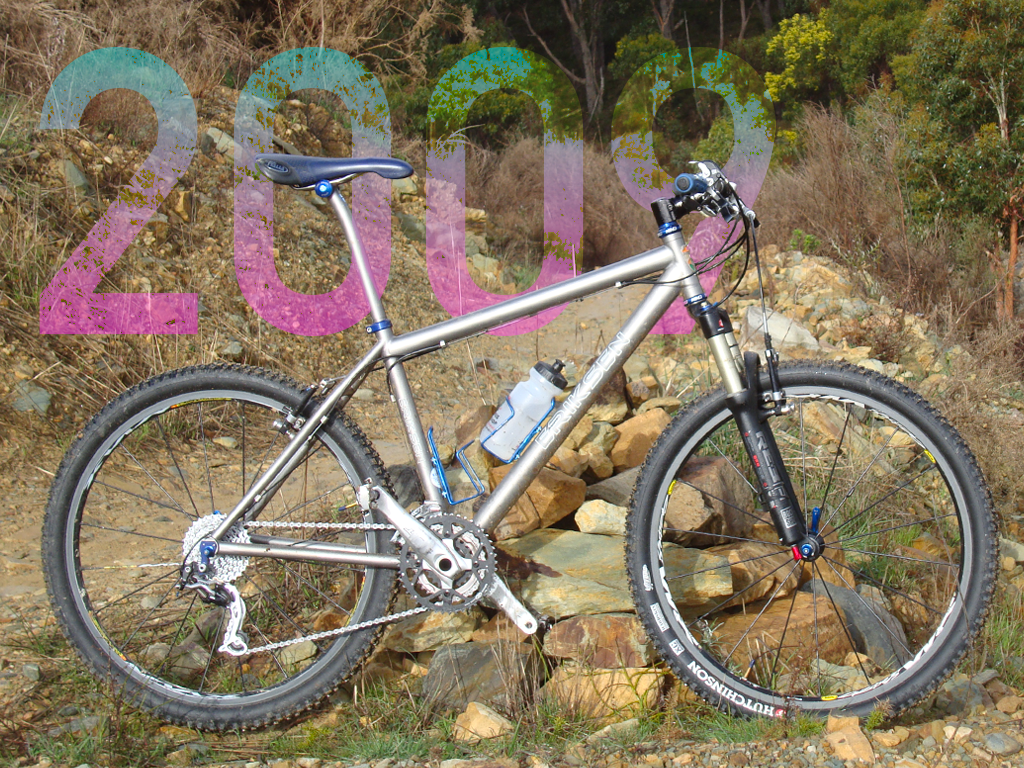
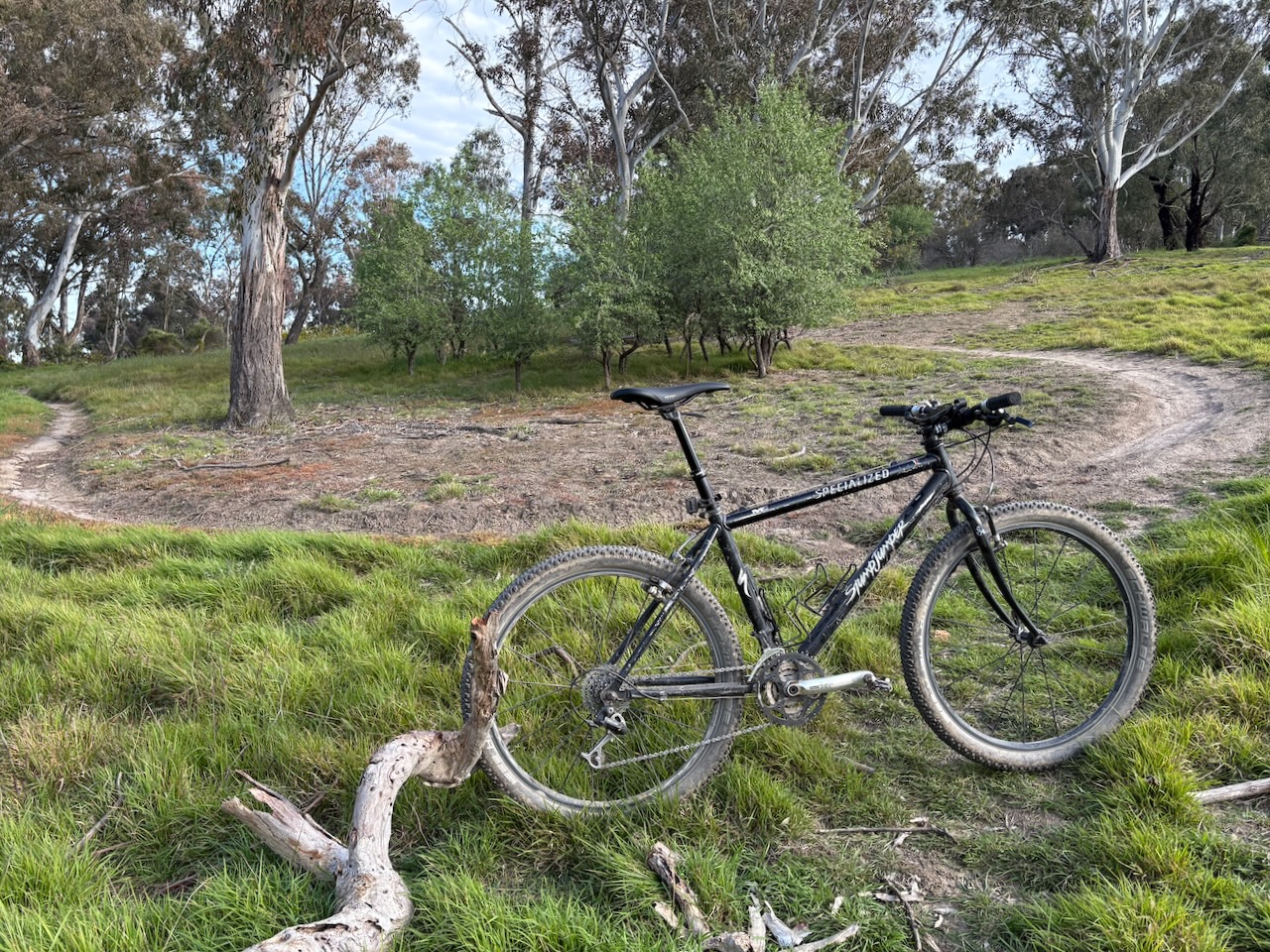
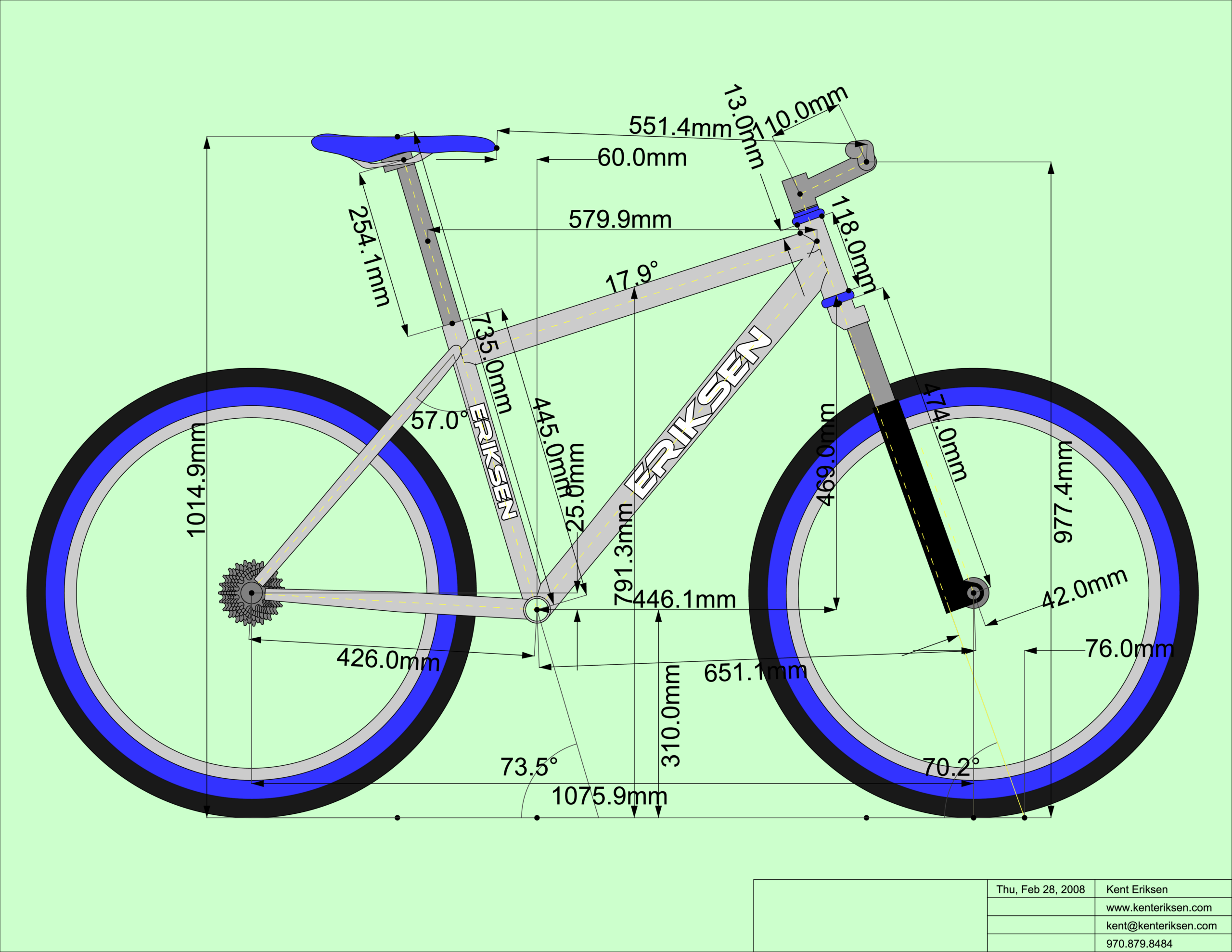
Do you remember my 1995 Specialized Stumpjumper M2 FS? I do, and I kind of have two of them. Let me explain. In 2008 I made the decision to build the bike I had wanted for years, a titanium Moots hardtail. I began this process looking at the current Moots frames and even test rode a YBB. Those elastomer-suspended YBBs are nice frames, and I think when combined with a Redshift stem could make an interesting dropbar conversion. Somewhere in my research into Moots I discovered that Kent Eriksen, the founder, had left and was building frames under a new name: Kent Eriksen Cycles. Soon after, I spoke with Kent and decided to go with one of his frames with a custom geometry. What was this custom geometry? It’s largely based on my 1995 Stumpjumper, but updated for a 100mm fork. So, that’s the ‘kind-of’ second Stumpjumper M2, and from that perspective, the 2008 Eriksen is a 1990s MTB.
Brief aside: I did visit Kent’s shop, Orange Peel Cycles in Steamboat Springs, Colorado. Sad to say but it, like Kent Eriksen Cycles, is no longer around. However, Bingham Built (the successor to Kent Eriksen Cycles) is still going.
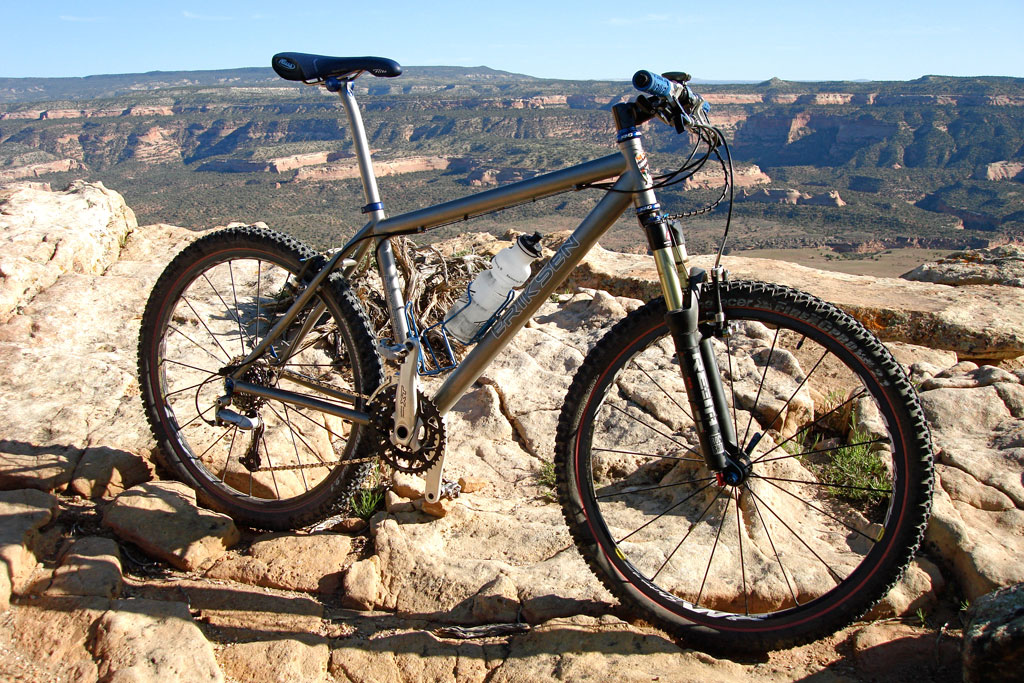
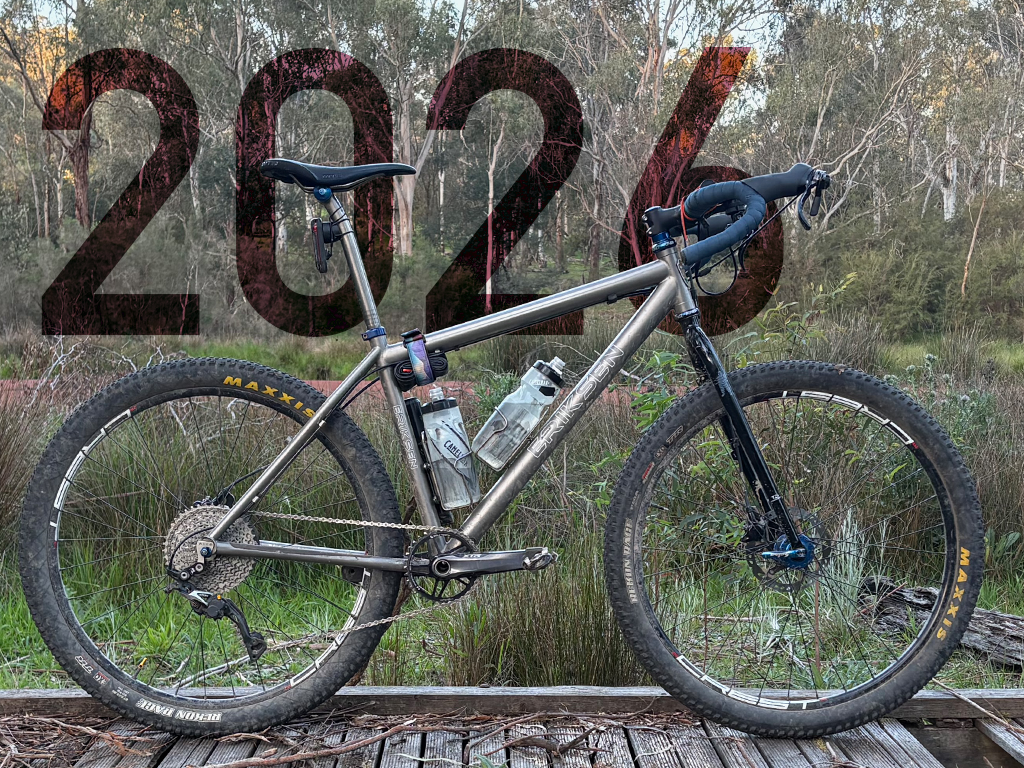
Back to the Erisken. I had been thinking about dropbar MTBs for years (often while riding technical singletrack on my 2001 Gunnar Crosshairs CX bike with 32mm tyres), and in early 2018 I finally did something about it. The Eriksen was my primary (flatbar) XC MTB, but had been gathering dust for a few years while I chose to ride my 2009 Kona Unit 29er rigid singlepseed or the move conventional 2017 Norco Sight 27+ 140mm hardtail or 2017 Giant Trance 27.5″ 130mm FS trail bike. So, I pulled out my boxes of spares and started swapping what was there for road and other dropbar components.
Initially, the Eriksen retained its original 26″ wheels, 100mm SID fork, and drivetrain, but gained some Salsa dropbars and Gevenalle GX shifters. Over the next several years I swapped the wheels for 650b, the fork for a rigid Kona P2, and eventually the mechanical BB7 discs for a new set of Gevenalle / TRP Helex hydros. I re-laced my very-blue c.2010 Hope Pro II hubs from the 26″ wheelset into these new 650b wheels, and these old hubs are still rolling along quite smoothly, but not so quietly with that Hope 24t ratchet.
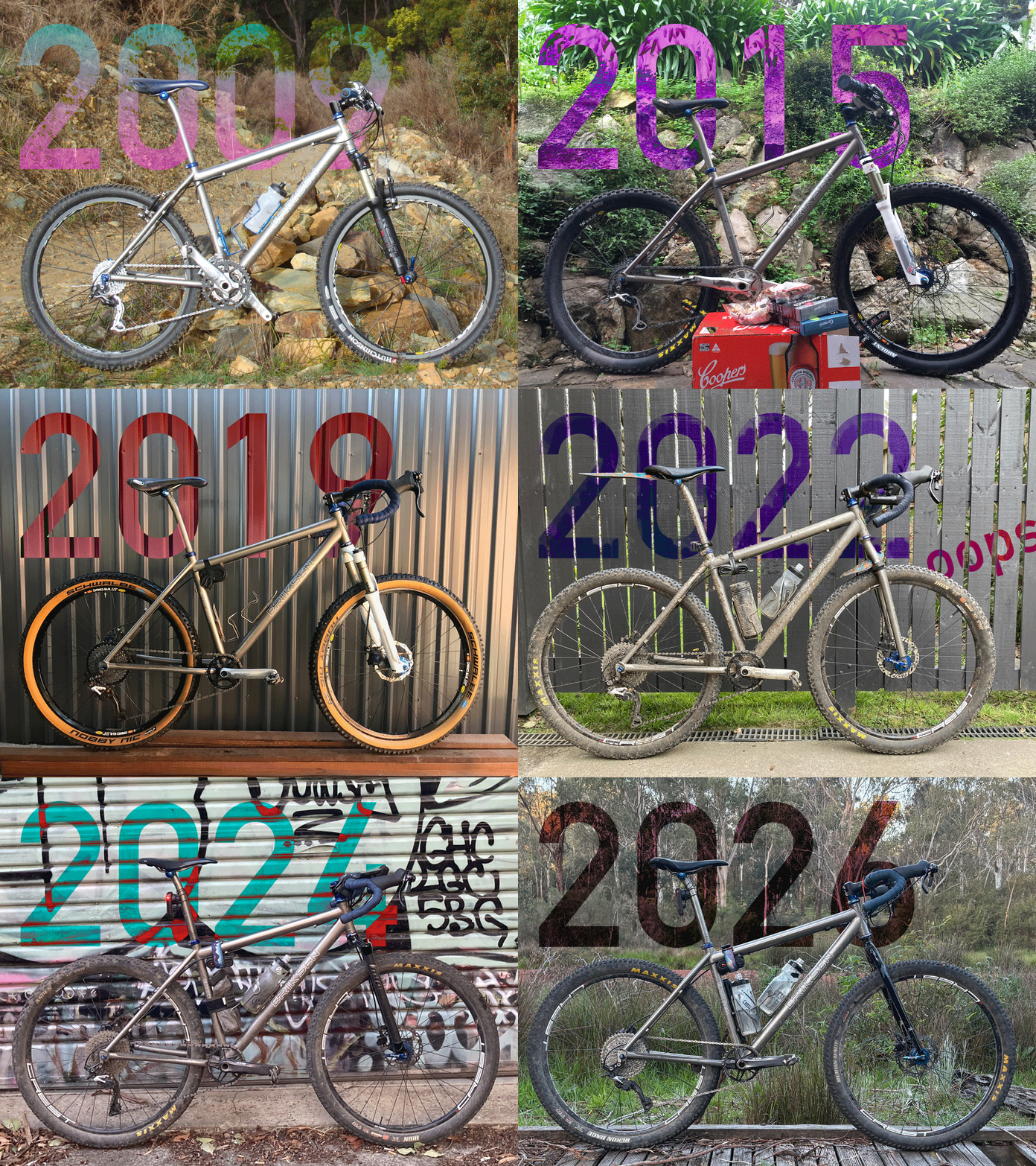
I put together a little animation of the changes over time. You can see the switch to dropbars and the changes each year after that. There was a small issue with a felled tree in 2022 that resulted in some light fork damage. Unfortunately, that Kona P2 fork was quite bent and replaced with a disappointingly harsh MRP carbon fork. I also experimented with a shorter A-C with that MRP fork but found it didn’t work well in technical sections. I searched for a while and eventually found an unused Niner steel fork on Pinkbike, which you can see in joins the party back in 2025 bringing back a lot of the fun feel the bike had with the P2 fork. I also swapped bars a few times, moving shallower and wider each time. I have found a shallow drop and large flare works well in technical riding, isn’t ideal in headwinds or group bunch rides, but is well suited overall to this type of bike and riding.
From the beginning the Eriksen was used on gravel and singletrack, and it still is today. Each step refined the bike as a dropbar MTB just a little, but I would say nothing really changed its overall character. These refinements addressed two main areas: rolling speed and control. Rolling speed was improved through both wheel diameter and tyre selection. The larger 650b wheels roll better through technical terrain, and the move from the more trail-oriented Schwalbe Nobby Nic to the fast-rolling XC Maxxis Ikon/Aspen and later Rekon Race helped over all types of terrain (except perhaps mud).
These Gevenalle levers deserve a little more attention as they were a key to my dropbar conversion.
Control was improved in two ways: braking and geometry/fit. First, the original Gevenalle GX (Tektro) levers and Avid/SRAM BB7 brakes were pretty good. I really liked the brake hood shape, and the BB7s are reasonably good mechanical disc brake calipers, but lacked the power and control of a good hydro. The Gevenalle / TRP Hylex setup that came next works very well with excellent power and control, and I even prefer these brakes to the Shimano and SRAM hydros I had or still have on other bikes.
These Gevenalle levers deserve a little more attention as they were a key to my dropbar conversion. The Eriksen used and uses a Shimano Dynasys 10-speed MTB drivetrain. Those familiar with Shimano drivetrains will probably recognise there is no easy path to using a Dynasys rear derailleur with a dropbar lever; Shimano road 10-speed uses a different cable pull ratio (the amount of cable the shifter moves for each gear shift) and the systems are incompatible. The kind people (goats?) at Gevenalle offer just about any shifter (including friction) with their levers and open the options considerably for drivetrain choice. For those unfamiliar, the Gevenalle levers are essentially a lightly modified brake lever (hydro or mechanical) and a Microshift downtime shifter mounted on the lever blade near the pivot with a clever machined aluminium adapter. These days there are more options for running MTB drivetrains with dropbar levers, but there’s still a good chance many will want to run older components on a dropbar MTB conversion, and I think Gevenalle is a good option. The availability of a really good hydro dropbar brake with a Shimano Dynasys 10-speed shifter and post-mount calipers is pretty amazing.
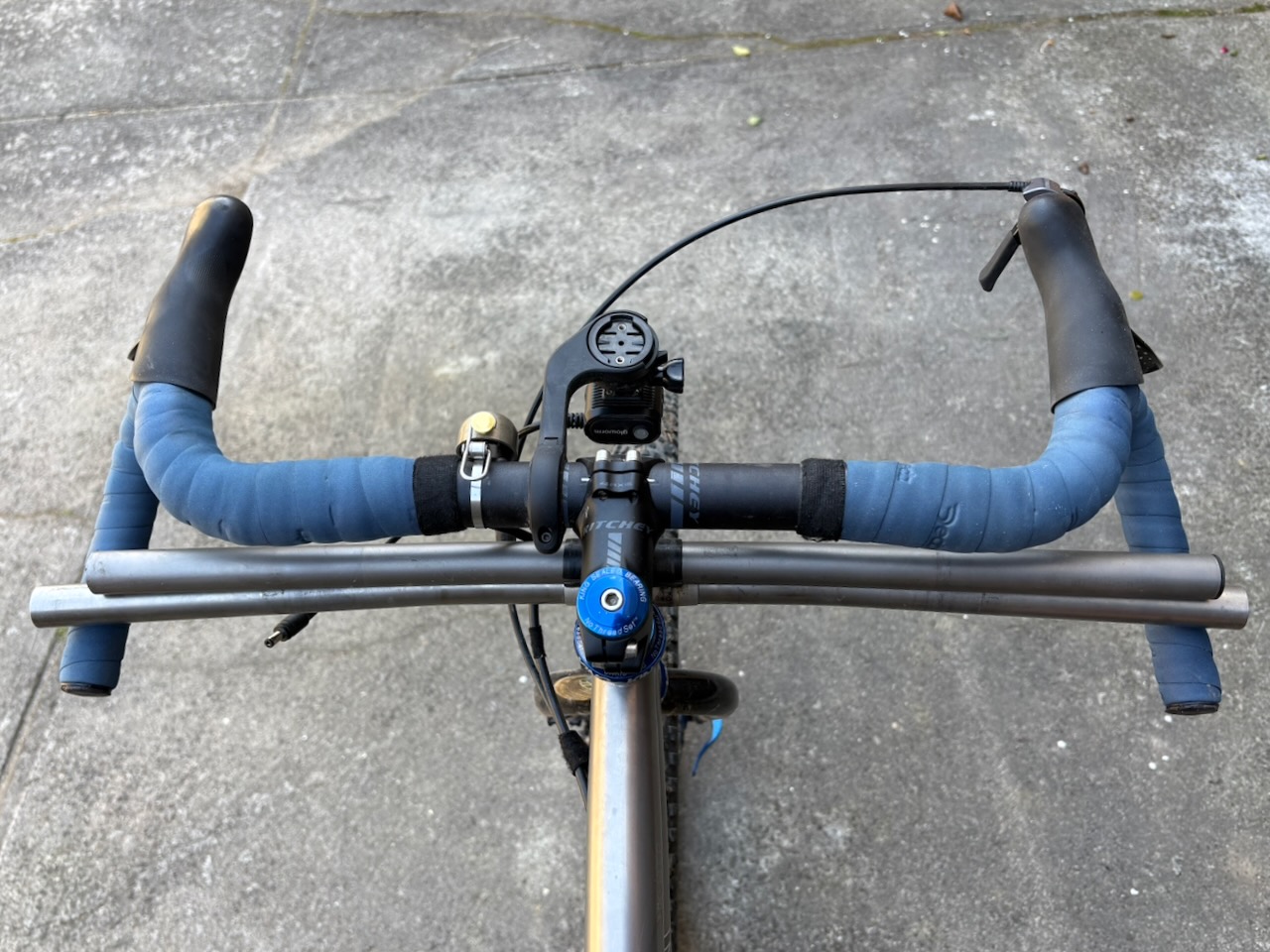
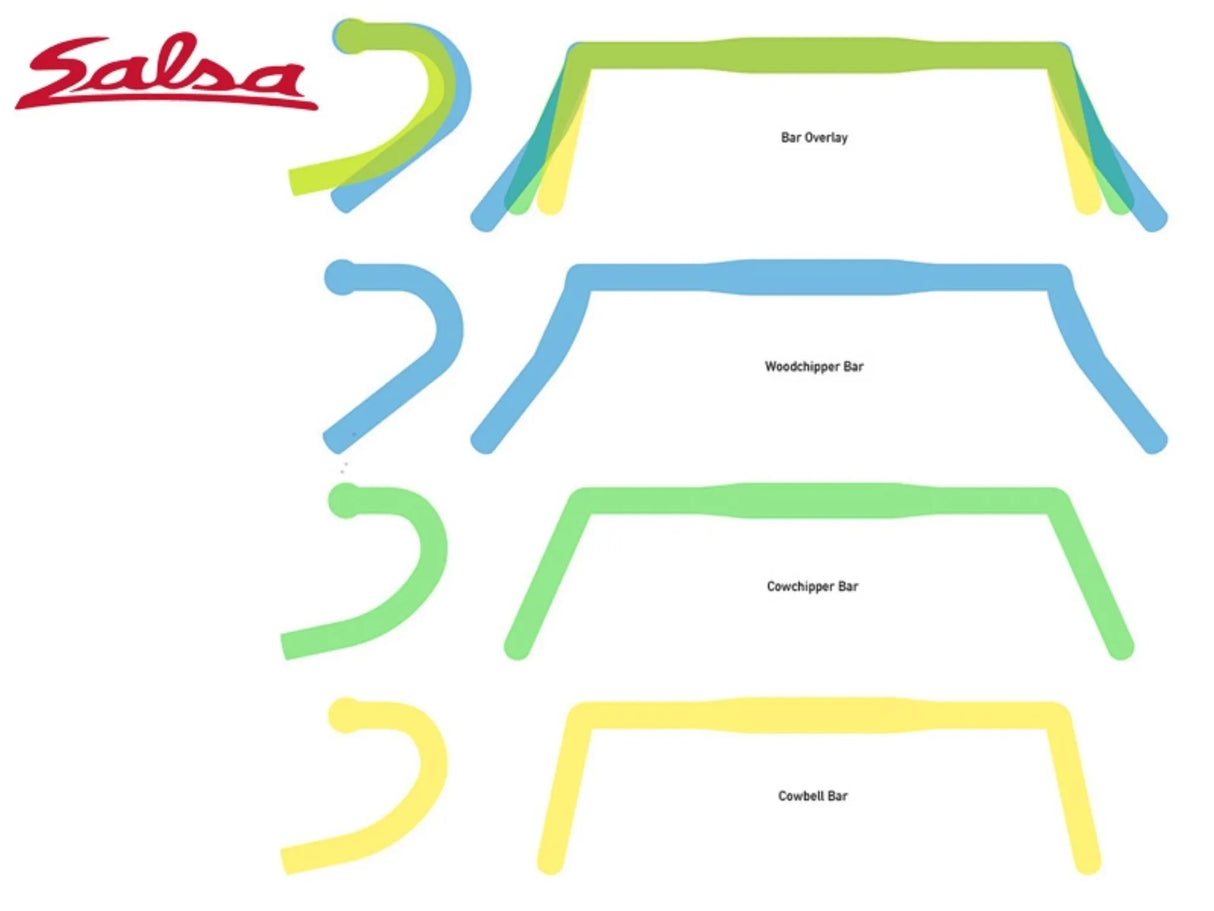
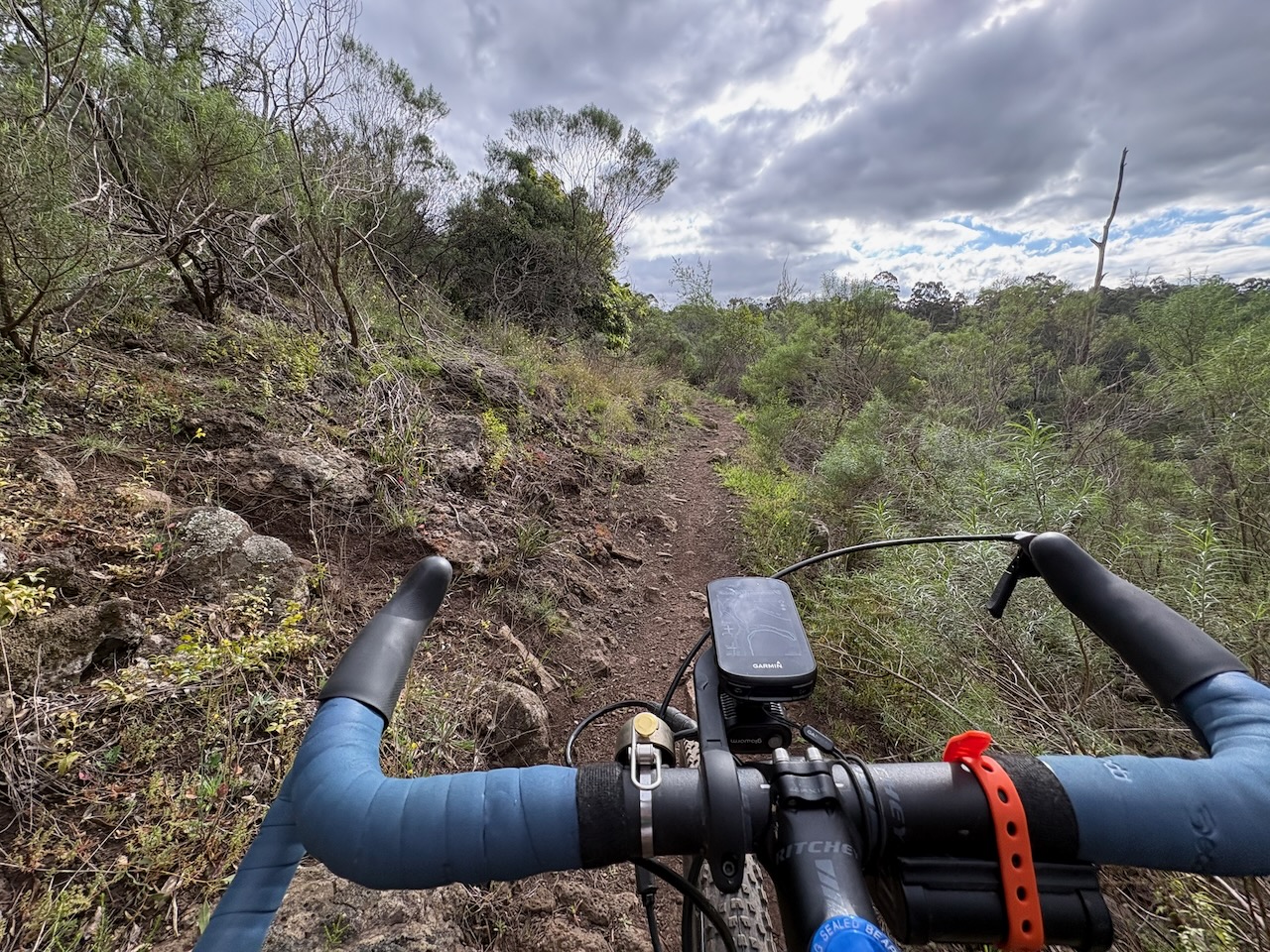
Second, geometry and fit were adjusted with simple bar swaps for width and/or shallower drop, stems were swapped for height and length, and forks were swapped for A-C (axle to fork crown) length and/or crash damage. The 44cm Salsa Cowchipper (great name) bars I initially used were reasonably good with a nice 24° flare, but the drops were pretty deep at 116mm and not ideal for a bike with an already low stack (vertical distance from the BB to the top of the head tube). The 46cm Ritchey Beacon bars currently on the Eriksen have a very shallow 80mm drop, a short reach, and a comfy 36° flare that maxes out at about 610mm, 10mm shy of the Kent Eriksen flat bars and 55mm wider than the original Titec bars I used in 2008 on the Eriksen as well as on the 1995 M2. The camera angle and precarious bar placement pictured below make the comparison difficult, but you get the idea.
Considering geometry a little more, we can see that most 1990s XC bikes have fairly long top tubes and reach (horizontal distance between the BB and top of the headtube) measurements and this combined with a short stem and drop bars just might result in a progressive, long-reach dropbar bike that seems to be pretty fashionable these days. Overall, the result of all of these changes is a bike better suited for singletrack and technical riding at the expense of aerodynamic efficiency (I don’t think there’s any of that left) and open road performance.
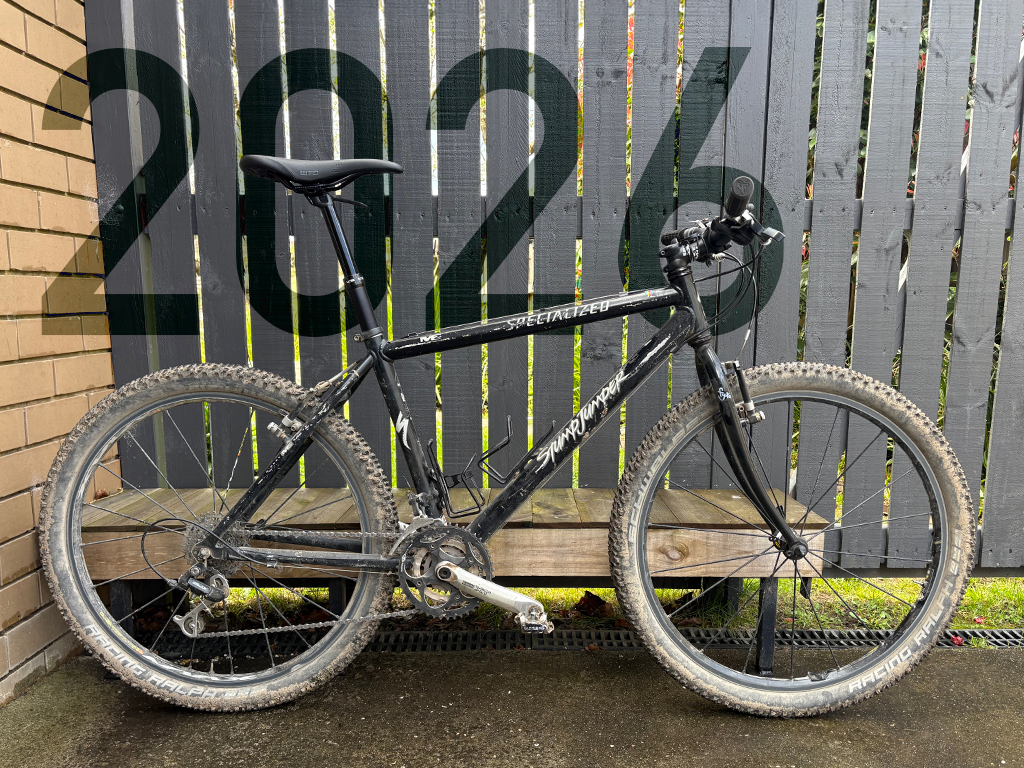
So, how similar is this dropbar MTB to a 1990s XC MTB? See for yourself. Both the M2 and the Eriksen are set up for me with very similar saddle heights, reach, and bar height. However, you’ll notice that one is stuck in the 1990s, and the other… 🤔 This addition of dropbars to this pseudo-1990s XC bike not only make it look funny, but opens up road(ish) hand positions making it more comfortable over long distances (the X in XC) as long as there’s not much of a headwind, and the wider, flared bars out there today still give you the width and leverage for technical riding (the C in XC). Most dropbar MTBs use a shorter, taller stem than you would typically use with a flat bar on the same frame, and this gives the further advantage of a more upright position when riding on the bar tops, a position similar to a traditional XC fit on the hoods, and a more aggressive/lower/wider position in the drops. That’s a lot of added versatility over an XC bike.
Dropbar MTBs sound okay, but what about gravel suspension?
1990s XC bikes began fully rigid, gained front suspension, and then rear suspension. Why wouldn’t we do the same on gravel bikes?
It’s hard to argue that some form of both front and rear suspension aren’t an advantage for comfort, efficiency, and control for most bikes in most situations. It’s also hard to argue that the surprisingly complex 50 hour service intervals required for most suspension is reasonable for gravel riding. Example: the top finishers in the Tour Divide usually have about 300 hours of ride time, so someone riding a Canyon Grizl with the DT Swiss fork would need five 50-hour services plus a 200-hour service during the course of this race, and you would be in a similar position on the Trek Checkout with its Rock Shox front and rear suspension. The Tour Divide is an extreme use case, but it doesn’t take too many rides to chalk up 50 hours. It’s fairly clear that most MTB suspension isn’t maintained on the recommended intervals, and I can see this issue being even more prevalent on gravel bikes. I don’t think there’s a right or wrong answer here, but this is all hard to justify when considering at the initial cost, servicing costs, complexity, and reliability of most gravel suspension.
This leads us back to dropbar MTBs. Why? You can gain many of the benefits of suspension through the large volume tyres and geometry found in an XC frame, but skip the cost, complexity, and maintenance of suspension. This is probably a dated view and perhaps a result of riding rigid bikes when I began riding MTBs in the early ’90s (and still choose to ride rigid most of the time), but I don’t think the benefits of suspension are always worth the tradeoffs for most people.
Counterpoint: Lauf Seigla. The Lauf gives you suspension without the maintenance (or damping) plus the tyre clearance of a 1990s XC frame in a new gravel bike. The Seigla is probably the single best argument against a dropbar MTB, and it comes in decent colours.
Each bike type has a distinct grouping, and gravel bikes are, in fact, not 1990s XC bikes.
Results and Discussion
Having conducted no research and having instead focused on generating some representative data (heavily skewed with my own personal bias) that allow the inclusion of a few jokes in visual form, I think the situation can be best summarised in this scatter plot of tyre width and handlebar rise/drop, grouped by bicycle type, with fitted vectors for supplementary (passive) variables revealing relationships with key attributes (Figure 1). I believe a reasonable interpretation of this plot reveals that each bike type has a distinct grouping, and gravel bikes are, in fact, not 1990s XC bikes and dropbar MTBs are a distinct group. We can also see that John Tomac’s early 1990s dropbar bike is an outlier and should not be used as evidence in any gravel-related argument.
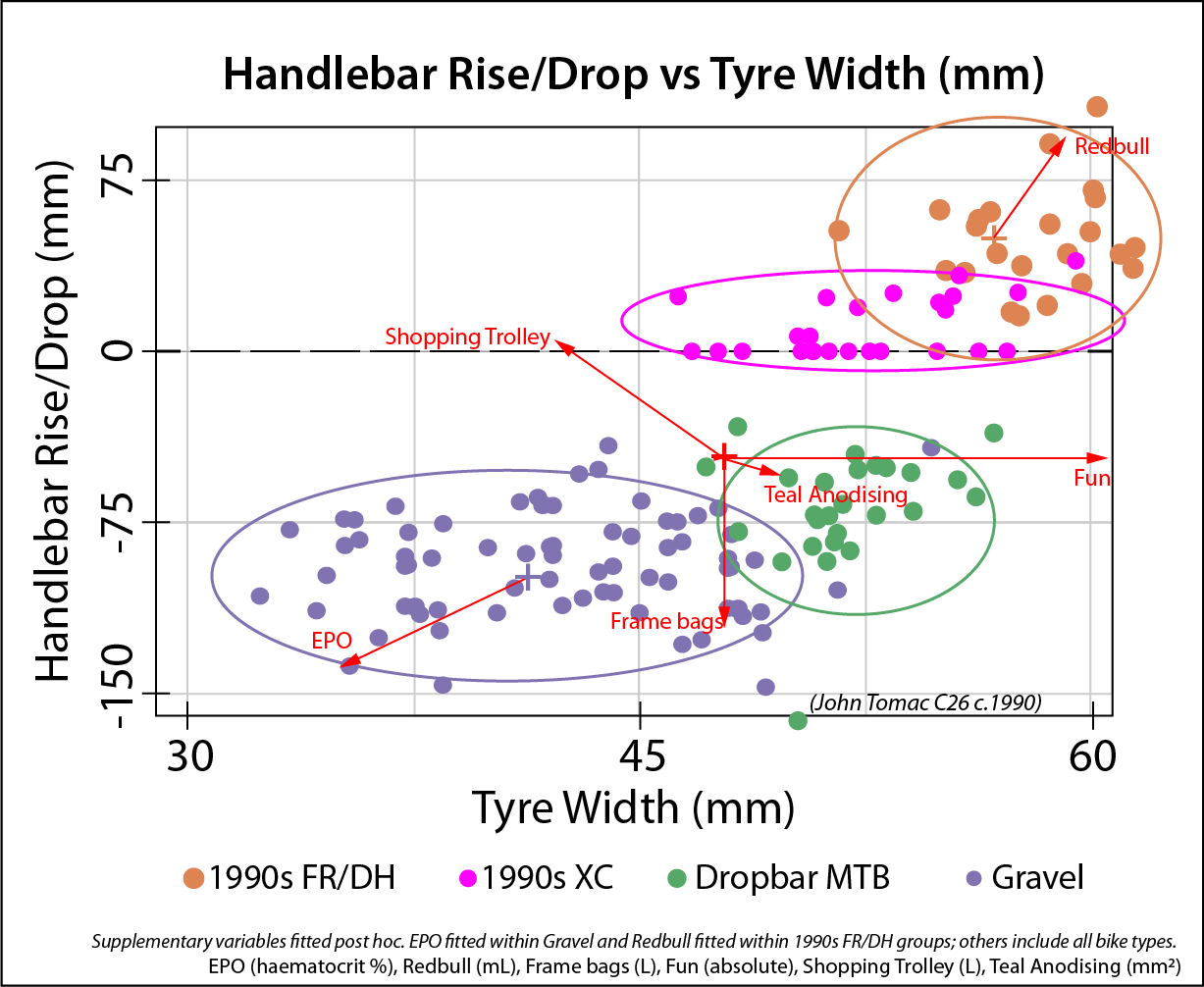
If we consider the passive variables (Redbull, EPO, fun, teal anodising, frame bags, and shopping trolley), we can see several potential correlations. While there are distinct associations between the FR/DH bike type and Redbull and teal anodising with dropbar MTBs, we can see that EPO appears to be associated with a subset of gravel bikes with narrow tyres and handlebars with deeper drops. What is most clear here, and the most important finding, is that fun is unequivocally correlated with tyre width and dropbar MTBs appear to be the best dropbar option for anyone who values fun.
Note that direction of the vector associated with each variable indicates which data points (bikes) across the plot exhibit more of this attribute, while vector length represents the strength of the attribute’s association with these bikes. The ‘+’ represent global or group centroids and show the average (bike) globally or for a group. Vectors originating from group centroids are associated only with these groups while the red centroid is global and apply to all bikes.
Further investigation into the potential relationship between crank arm length, average cadence, and EPO is warranted and may provide additional insight into the association between tyre width and handlebar drop.
Just to be clear, there are no actual data here. This plot is a joke that I created in Illustrator with detail right down to the overlapping elements, inconsistent font sizes, and adherence to convention in spite of visual appeal.
Conclusions
It’s clear that we all have our own idea of what gravel is and what makes a good bike for whatever situation. A road bike can be a great gravel bike, and so can an XC MTB, but they’re not both going to be idea for everyone. I consider green, blue, and the occasional black MTB singletrack to be a reasonable part of gravel ride. Because of this, a 1990s XC bike can be an excellent bike for some of my gravel rides. However, these 1990s XC MTBs are not gravel bikes, but rather they can make excellent dropbar MTBs, and dropbar MTBs are fun, versatile bike that are a lot more useful and practical than many of the mainstream gravel options out there.
Do you want a dropbar MTB but don’t have any 30+ year old XC frames lying around? First, I’m sorry to hear that. Second, I’m not the only one out here on sketchy singletrack with my dropbars and knobby tyres. Check out the Cotic Cascade. Just look at those external cables. Look at the bosses. Look at the lack of garbage going through the headset. Amazing. Other than that, there’s always hard rubbish or eBay.
Addendum
During the course of writing about dropbar MTBs GCN released the Is A Gravel Bike Still Just A Dated Mountain Bike? video. I thought about using it as a mock literature review to extend my joke of presenting my thoughts on these odd bikes as an academic paper, but that seemed a bit much and there’s less content in this nearly 20 minute video than one might hope. Instead, here are my (brief) thoughts about the video.
Between product shots of their sponsor’s (Canyon) gravel bike, they do briefly discuss the use cases for the two types of bikes, point out some of the advantages of each bike, mention the poor suspension performance of the era, and recognise the importance of anodised aluminium and other aesthetic qualities of the bikes. This all sounds familiar. They also tested both bikes on a range of terrain from sealed roads, gravel, to singletrack. Also familiar and reasonable.
However, what they absolutely overlooked was that the splatter paint on this $9,000AUD(‽) 2026 Canyon Grail CFR owes quite a large debt to the splatter-painted GTs (an other MTBs) from the 1990s. This seems like a pretty glaring oversight and would have fit better in the video than the awkward inclusion of the meaningless 7w of aero drag improvement in a wind tunnel at highway speeds or any of the other press release statements they repeated.
Unsurprisingly, they found a lot of nice things to say about their sponsor’s bike and had more than a few (generally justified) criticisms for the “old man bike”, a 1994 GT Zasker LE. In the end, they determined that gravel bikes and ‘dated mountain bikes’ shared little in common and the Canyon is great. None of this is surprising as the question asked and the video are clearly just a vehicle to advertise the Canyon, and it’s not bad when viewed from this perspective.
Does the video answer the question posed or add much to this discussion? No, not really in any satisfying way. But, I will suggest here (as I did earlier) the best answer to their question is probably “dropbar MTB”. That GT might have been a lot more fun with some dropbars and a couple of fast rolling XC tyres from this decade (or at least this millennium).
Leave a Reply